The Sunwake Project
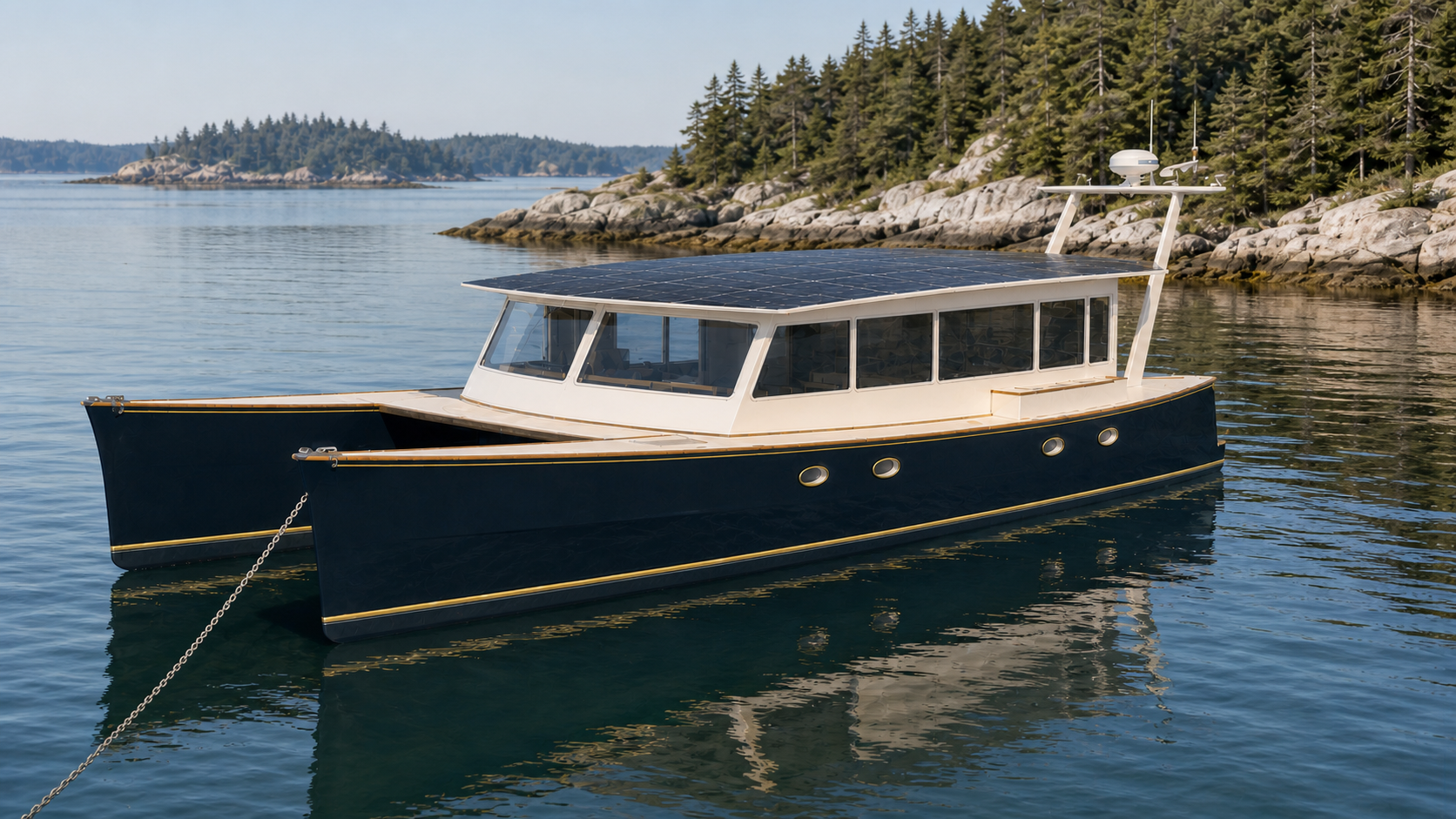
A 15 m stitch-and-glue solar-electric cruising catamaran for four, built by its owner. It cruises at 7.3 knots on sunlight alone, 8.2 on one generator, and can reach 15.6 knots for short periods. The planned cruising grounds are coastal Maine, the ICW, the Great Loop and the Bahamas.
What this is
Sunwake is a developed design concept for an owner-built, taped-seam plywood and epoxy catamaran with a professionally engineered high-voltage electrical system. The work is public so naval architects, suppliers, insurers and other builders can examine the assumptions and offer informed criticism.
The project is maintained as a working repository. A table of offsets defines the hull and feeds the hydrostatics, power model, endurance calculations, drawings and interactive explorer. The test suite checks that published figures match the calculation package. If a document and the code disagree, use the code as the authoritative design basis.
Explore the hull, read the design brief, or review the open engineering questions.
Start here
Design brief
Sunwake SW-15 · SW-BRIEF Rev 0 · August 2026
03Lines plan SW-LP01 Rev 0a
Sunwake SW-15 · SW-LP01 Rev 0a · August 2026
04Hull form study: useful facet count for a chined hull
Sunwake SW-15 · SW-FORM Rev 1 · August 2026
07Power and energy
Sunwake SW-15 · SW-PWR Rev 1 · August 2026
10Electrical architecture and insurability
Sunwake SW-15 · SW-ELEC Rev 1 · August 2026
14Open engineering questions
Sunwake SW-15 · SW-ENG Rev 1 · August 2026
Where the design still needs work
The Bahamas draft target has no spare margin. At 0.95 m to the propeller tips, the boat meets the stated limit exactly. The lines plan proposes a wider-waterline refair with no measurable power penalty in the model. This is the most consequential open hull decision.
Absolute power estimates carry ±25–30% uncertainty. Comparisons between variants are more precise, but the residuary resistance is calibrated from an existing curve and carries its limitations. CFD or tank testing is required before lofting.
Insurance needs to be addressed early. Owner-built wooden hulls and professionally installed high-voltage propulsion are each insurable, but there is limited precedent for combining them. The proposed approach is set out in the electrical and insurability study.
How the project is organized
The documents are in docs/, the
calculation package in calc/, generated data in data/,
generated drawings in drawings/, and this site in site/.
For a compact overview, data/design_summary.json contains the main
particulars, hydrostatics, speeds, ranges and design margins. AGENTS.md
explains the project conventions and where the remaining engineering work sits.