Performance
Everything on this page is computed, not quoted. Friction and air drag come from the hull the offsets generate; residuary resistance is calibrated against the design basis curve; a Michell thin-ship model runs alongside as the physical check. Absolute powers carry roughly ±25–30% uncertainty, widening near the hump. Comparisons between variants are far tighter. The method, and where to attack it, is in power and energy.
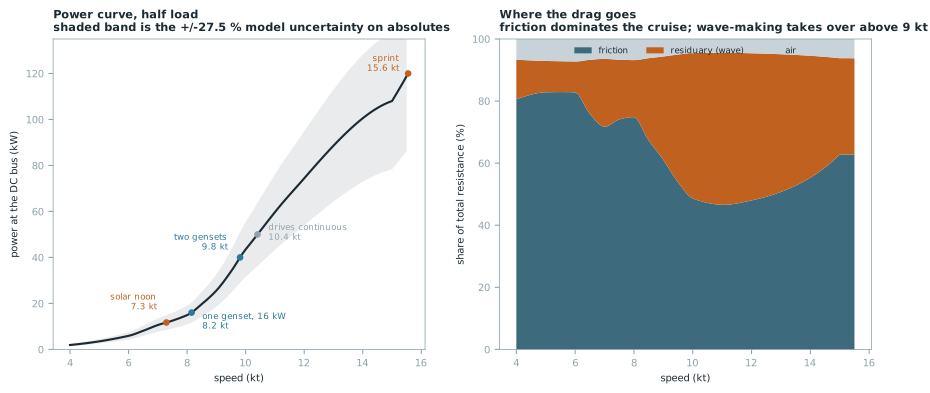
The power curve
| Speed (kt) | Froude | Bus power (kW) | kWh per nm | Wave share |
|---|---|---|---|---|
| 4.0 | 0.1697 | 1.9 | 0.47 | 13% |
| 5.0 | 0.2121 | 3.5 | 0.70 | 10% |
| 6.0 | 0.2545 | 5.9 | 0.98 | 10% |
| 6.5 | 0.2757 | 8.1 | 1.25 | 17% |
| 7.0 | 0.2969 | 10.6 | 1.51 | 22% |
| 7.5 | 0.3181 | 12.5 | 1.67 | 19% |
| 8.0 | 0.3393 | 14.9 | 1.86 | 18% |
| 8.5 | 0.3605 | 19.7 | 2.32 | 26% |
| 9.0 | 0.3817 | 25.6 | 2.84 | 33% |
| 9.5 | 0.403 | 33.9 | 3.57 | 41% |
| 10.0 | 0.4242 | 43.5 | 4.35 | 47% |
| 11.0 | 0.4666 | 59.7 | 5.43 | 49% |
| 12.0 | 0.509 | 74.4 | 6.20 | 47% |
| 15.0 | 0.6362 | 108.0 | 7.20 | 31% |
What the boat's own power sources hold
| Source | Available (kW) | Continuous speed (kt) |
|---|---|---|
| Clear noon, 15 kWp array alone | 11.7 | 7.29 |
| Ordinary bright day | 8.6 | 6.60 |
| Haze or shoulder season | 5.7 | 5.93 |
| One generator at its sweet spot (16 kW) | 16.0 | 8.15 |
| One generator at rating | 20.0 | 8.53 |
| Two generators at 16 kW each | 32.0 | 9.39 |
| Two generators at rating | 40.0 | 9.81 |
| Two generators plus noon sun | 51.7 | 10.51 |
| Drives at continuous rating | 50.0 | 10.40 |
| Sprint, two-minute peak | 120.0 | 15.55 |
The sustained ceiling is set by the drives rather than by the hull: 50 kW of continuous drive rating holds 10.4 knots, and two generators plus noon sun would hold about the same. That is a well-matched plant rather than a coincidence.
Weight is the lever. Every 500 kg out of the boat is worth about 0.11 knots at solar noon, which is why the weight ledger is treated as a performance instrument.
The rating reference plane
Every power figure in this project is DC electrical input at the high-voltage bus. Some vendor catalogs rate shaft output instead, and on this boat that difference decides a pass or a fail:
| Reference plane | Bank draw at sprint | C-rate on 128 kWh | Against the ≤ 1C limit |
|---|---|---|---|
| DC input at the bus | 120.0 kW | 0.938C | passes, thinly |
| shaft output | 133.3 kW | 1.042C | over the limit |
Silent endurance
| Speed (kt) | Bus power (kW) | Dark (hours) | Dark (nm) | With bright-day sun (nm) |
|---|---|---|---|---|
| 5.0 | 3.5 | 29.26 | 146.3 | unlimited in daylight |
| 6.0 | 5.9 | 17.36 | 104.1 | unlimited in daylight |
| 7.0 | 10.6 | 9.66 | 67.6 | 358.4 |
| 7.5 | 12.5 | 8.19 | 61.4 | 196.9 |
| 8.0 | 14.9 | 6.87 | 55.0 | 130.0 |
| 8.5 | 19.7 | 5.2 | 44.2 | 78.4 |
| 9.0 | 25.6 | 4.0 | 36.0 | 54.2 |
| 10.0 | 43.5 | 2.35 | 23.5 | 29.3 |
Generator range on 600 L of HVO
| Speed (kt) | kWh per nm | Range (nm) |
|---|---|---|
| 7.0 | 1.514 | 1149–1268 |
| 7.5 | 1.667 | 1044–1152 |
| 8.0 | 1.862 | 934–1031 |
| 8.5 | 2.318 | 751–828 |
| 9.0 | 2.844 | 612–675 |
| 9.5 | 3.568 | 488–538 |
| 10.0 | 4.35 | 400–441 |
Fuel converts at 2.9–3.2 kWh of bus energy per liter. The 600 nm passage requirement is met with real reserve at 8–8.5 knots and only thinly at 9.
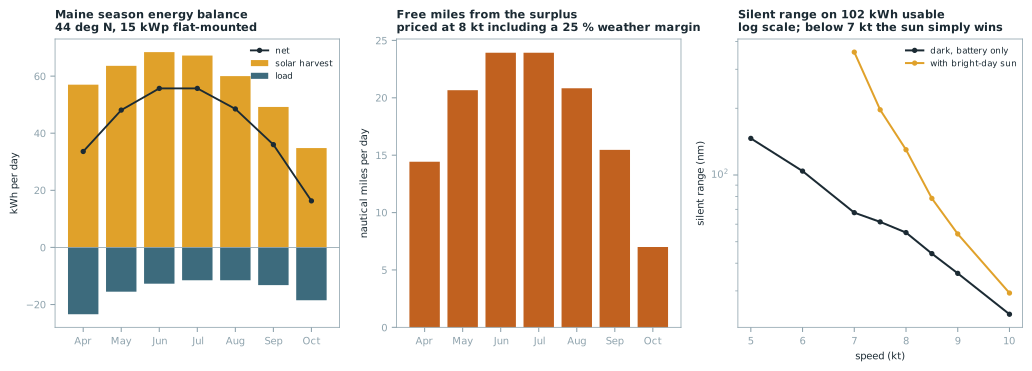
The Maine season
| Month | Solar (kWh/day) | Load (kWh/day) | Net | Free miles/day |
|---|---|---|---|---|
| April | 57.0 | 23.4 | 33.6 | 14.4 |
| May | 63.6 | 15.5 | 48.1 | 20.7 |
| June | 68.4 | 12.7 | 55.7 | 23.9 |
| July | 67.2 | 11.5 | 55.7 | 23.9 |
| August | 60.0 | 11.5 | 48.5 | 20.8 |
| September | 49.2 | 13.2 | 36.0 | 15.5 |
| October | 34.8 | 18.5 | 16.3 | 7.0 |
Free miles are priced at 8 knots including a 25% weather and fouling margin. Over the season the array harvests about 12,232 kWh against a load of about 3,246 — roughly 3,860 free nautical miles a year. November goes negative and the boat hauls out.
Twin-hull interference
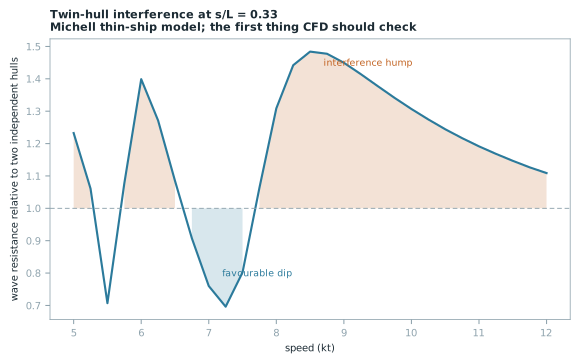
This is the first CFD check. If the dip is real, then it is worth more than any other hull decision available; if the hump is real it argues for either a different spacing or a different passage speed. Discussion in the hull form study.
Computed hydrostatics
| Quantity | Value |
|---|---|
| Displacement, half load | 12.68 t |
| Draft, canoe body | 0.675 m |
| Demihull waterline beam | 1.404 m |
| Length to beam | 10.68 |
| Volumetric slenderness L/∇^⅓ | 8.17 |
| Prismatic coefficient Cp | 0.592 |
| Midship coefficient Cm | 0.735 |
| Block coefficient Cb | 0.435 |
| Waterplane coefficient Cwp | 0.731 |
| LCB | 53.9% LWL |
| LCF | 58.1% LWL |
| Maximum section area | 0.696 m² at 60% LWL |
| Wetted surface, both hulls | 48.4 m² |
| Waterplane, both hulls | 30.80 m² |
| Metric tons per cm immersion | 0.316 |
| KB / BMt / GMt | 0.44 / 15.9 / 14.5 m |
| Transom immersion | 109 mm |
| Entrance half-angle | 5.9° |
Source data:
data/power_curve.csv, data/endurance.csv,
data/generator_range.csv, data/solar_monthly.csv,
data/interference.csv, data/hydrostatics.json.